Posts

Showing posts with the label Adam S.

Do Some Have Better Spiritual Gifts?

Image
Does it ever feel like people you know are more “spiritual” than you are? Like they have more opportunities to influence people for God’s kingdom than you do? Do you ever struggle with the comparison game: “if I had more charisma, I could lead more people to Christ,” or, “why can they understand the Bible so easily and I can’t”, or even “they must be a better Christian than I am, look at all their talents they can serve the church with!” The struggle in comparing ourselves to others is a legitimate one that everyone faces—even the people who appear the “most talented” or “most spiritual” can struggle with this. Does God really bestow better spiritual gifts to some and not others?  The answer is both yes and no. Differing Gifts “For through the grace given to me I say to everyone among you not to think more highly of himself than he ought to think ; but to think so as to have sound judgment, as God has allotted to each a measure of faith . For just as we have many members in on...
Why Hasn't Jesus Come Back Yet?

Image
 One of Jesus’ pivotal teachings is that he would bring an end to the world as we know it. Jesus made this promise over 2,000 years ago. The early church was convinced that Jesus’ return would be imminent because he said that he would be “coming soon” (Rev 22:12, 20).  Now here we are all this time later and Jesus still hasn’t returned. What’s the hold up? Why is there a delay? What is so exciting is that Scripture gives us a direct, explicit answer to this very question; we don’t have to make an inference or an implication. Peter shares God’s direct answer to this question in the third chapter of his second letter. The “Hold Up”  — More to be Saved The explicit answer is found in verse 9 (with some important context to strengthen his rhetoric), “The Lord is not slow to fulfill his promise as some count slowness, but is patient toward you, not wishing that any should perish, but that all should reach repentance.” It seems as if the Lord is taking a long time to return...

God's True Character: Exodus 34:6–7

Image
 Who is God, or more specifically, Yahweh—God as defined and worshiped in the canon of the Bible? Our instincts may lead us to the New Testament—the revelation of Jesus Christ. But how did the Hebrews (and later the Jews) understand who God was? We hear of the supposed dichotomy between the “God of the Old Testament”—wrathful, punishing, and selective and the “God of the New Testament”—loving, merciful, and inclusive . Yet one of the most important, if not the most important, thesis statements about God’s character in the entire Bible is found in the Old Testament (Hebrew Bible/Tanakh). Its the most quoted verse within the Old Testament, Exodus 34:6–7: “Yahweh, Yahweh, a God merciful and gracious, slow to anger, and abounding in steadfast love and faithfulness, keeping steadfast love for thousands, forgiving iniquity and transgression and sin, but who will by no means clear the guilty, visiting the iniquity of the fathers on the children and the children's children, to the third an...

Jesus The Disrupter: Luke 2:34–35

Image
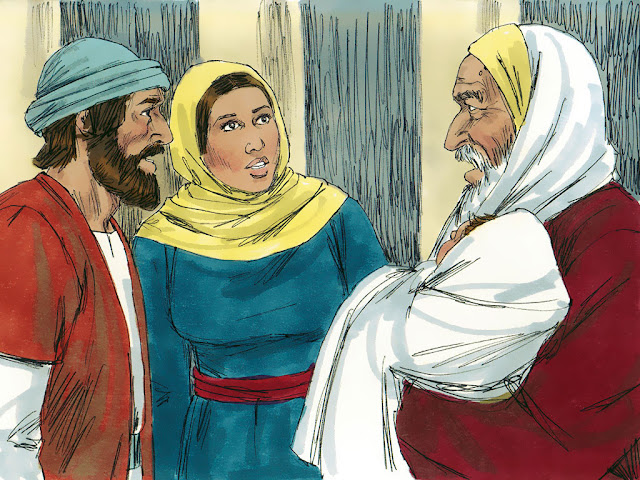
 Some forty days had passed and it was time for Mary to purify herself, according to Levitical law. By a miracle, Mary had bore the baby Jesus but had not slept with any man at this point.  Here we meet the famous Simeon, who had been promised to see the Savior in the flesh during his lifetime. He praised God and announced to everyone in the temple courts how the baby would bring Salvation to all people. CC-BY-SA Sweet Publishing Yet, those were not his last words concerning Jesus. Imagine Simeon holding baby Jesus in his arms and declaring the future Salvation, but then pivoting his stance towards Mary to speak a blessing to a her: “. .  . this child is appointed for the fall and [rise] of many in Israel, and for a sign that is [spoken against] (and a sword will pierce through your own soul also), so that thoughts from many hearts may be revealed.” Luke 2:34–35 ESV Jesus was the Savior, and this required a great disruption to people’s lives. He later said about himself:...

The Sign of the Rainbow

Image
 If you are like me, it is easy to take signs of God’s love found in nature for granted. The other day, when I was out walking, a ginormous natural sign hit my eyesight—a rainbow. I’ve seen rainbows many times, but on that day the Spirit stirred my heart, “Remember the rainbow!” I think there is more to the rainbow than what we make of it, biblically speaking. In today’s world the rainbow is used to represent everything from Autism awareness, to worldly views of human sexuality and gender, to a happy (and inaccurate) representation of the Great Flood that adorns the signage of Christian preschools. What does the Bible say about the rainbow? When the rainbow enters our gaze, what thoughts should come to mind? The promise of the rainbow has meaning for God, Humanity and Animal kind:  God  After Noah and representatives of all kinds of animals disembarked the ark after the Great Flood, God made a covenant with them all, setting a rainbow in the sky: “This is the sign of the ...

Soul-Searching: Psalm 139

Image
What does it mean to search for something? A search is not a low-energy effort to find something. A search is a deep, intense probing that will not stop until something is found.  How do we search? We pour through our environment intently looking to find that which we are seeking. That is what we must ask God to do in our own hearts, “Search me, O God, and know my heart! Try me and know my thoughts! And see if there be any grievous way in me, and lead me in the way everlasting!”- Psa 139:23-24 In Psalm 139, David is both asking God to and recognizes that he searches the heart. This idea of God searching our heart sandwiches (inclusio) the body of the Psalm, which describes God’s intimate knowledge of us in great detail, “You know when I sit down and when I rise up; you discern my thoughts from afar. You search out my path and my lying down… and are acquainted with all my ways.”-  Psa 139:2 “Where shall I go from your spirit? Or where shall I flee from your presence? If I ascen...

A Bad Trade-In (Jeremiah 2)

Image
 What is the best, most refreshing water you have ever had? I know some of the best water I have ever had is an ice cold, bottled water or water from a cold fountain Say you had a choice between cold, refreshing and satisfying bottled water or a glass of lukewarm tap water- which would you choose? (Maybe a bad analogy) If you are like the Israelites or any other human being who has lived on the planet- we will often opt for the lukewarm tap water over the bottled water. It can be the same with God. That’s what God calls our attention to in Jeremiah 2. The Israelites had access to cold bottled water but settled for the lukewarm tap water. “I remember the devotion of your youth, your love as a bride, how you followed me in the wilderness, in a land not sown. Israel was holy to the LORD, the firstfruits of his harvest. All who ate of it incurred guilt; disaster came upon them”- Jeremiah 2:2-3 In the past, Israel experienced the favor and protection of God as they had total devotion, c...

You Aren't Too Good For Any Service: John 13:1-20

Image
Imagine the most menial and humiliating work you can do for others. In the Western world we often use maids as the stereotypical, lowly servant. Other occupations that come to mind are waiters, sewage workers and trash collectors. These are the tasks no one wants to do, because everyone would like to think they are above them. These tasks are not glamorous in any way, but they may be hard, dirty or demanding work positions.  In Jesus’ day, washing feet was a task reserved for the servant. People did not have neatly paved roads, sweeper trucks and covered shoes that kept their feet relatively clean. When someone entered a house, the servant would wash their feet. This was one of the lowliest and most humiliating jobs anyone could have had. Yet, Jesus did this- and with effort and willingness.  John 13:1-20 contains the account of Jesus washing the Apostles’ feet. This is a very significant moment in the ministry of Jesus that not only gives us insights into Jesus' nature, but h...

Boast in the Lord

Image
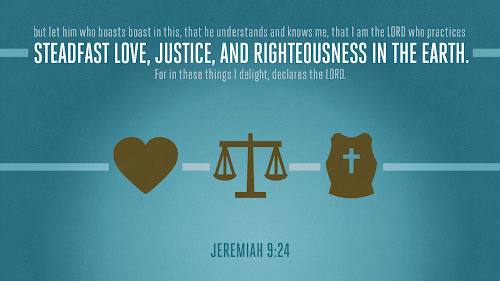
© Faithlife Corporation What are you proud of in your life? What do you identify with? Do you think your behavior will excuse or vindicate you?  The people of Judah thought that their exterior religiosity insured them against punishment for their inward vileness. Can’t we be guilty of the same?  Through the prophet Jeremiah, God laid forth his future punishment of Judah’s sins very clearly as a warning for the people to turn away from their sins. Chiefly, they had abandoned God and had turned to worshipping the false gods of Ba’al, as if they had chosen water from a dirty and leaky cistern over  pure, fresh and clean water from a spring (Jeremiah 2). In addition, the Jews had been treating each other harshly with no concern for the needy, instead trusting in political alliances and their own inflated sense of righteousness to advance “goodness” in their country.  

Little Faith or Mustard Seed Faith?

Image
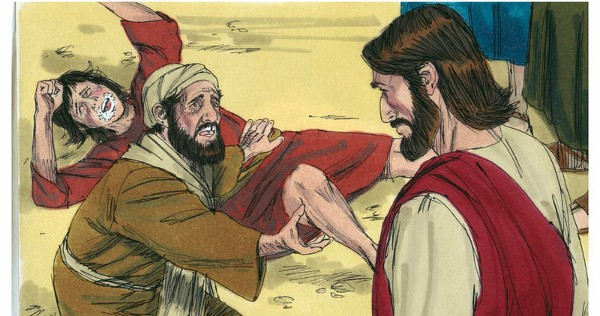
The healing of the demoniac boy offers much enlightenment regarding the nature of faith. In the previous post I explored how faith (an action), though genuine, may come with a sense of doubt or unbelief (a noun). In this post we are going to explore the bewildering reason why the Apostles could not cast it out. To be very clear I have done a post before dedicated to exploring why the Apostles could not drive out the demon- while my previous study was right, I largely missed the point and neglected the more specific lessons on faith. After the Apostles could not cast the demon out from the boy, they asked Jesus why they could not cast it out. Jesus gave two responses: “This kind cannot be driven out by anything but prayer” (see Jesus Heals the Demon )  and  “Because of your  little faith . For truly, I say to you, if you have faith like a grain of mustard seed , you will say to this mountain, ‘Move from here to there’, and it will move, and nothing will be impossible for...

Faith Amid Unbelief

Image
Can unbelief and faith coexist? At first glance, one would be inclined to say “Absolutely not!”. Afterall verses such as John 3:18 say,  “Whoever believes in him is not condemned, but whoever does not believe is condemned already, because he has not believed in the name of the only Son of God.” How then do we explain the remarkable proclamation of a man with a demon-possessed son in Mark 9,  “I believe; help my unbelief!” - Mark 9:24b Jesus had been on a mountain with three disciples, “transfiguring” himself to display his full glory. While this happened, Jesus left the remaining Apostles in Caesarea Philippi. During this time, a man approached the Apostles asking them to heal his son who had been possessed by a demon. The Apostles were unable to perform this healing, and this stirred up arguments within the crowd. When Jesus returned and asked about all the commotion the father approached him and explained how the Apostles were unable to heal his son. So Jesus called out the...

Six Ways to Praise God (Psalm 105)

Image
Psalm 105 describes 6 ways to praise God:  Thank him (vs 1) “Call on his name” declare who God is to God Declare his works to everyone (vs 1b, 2b) Sing to God Seek him Remember him (The six ways are based on general concepts that appear to be the same, not on verbal form). While all six of these elements are important, Psalm 105 is principally concerned about the sixth way - remembering what God has done. It is on the basis of remembering that the other five acts of worship are done. First, the Psalm remembers the covenant God made with Abraham that he then reaffirmed with Isaac (his son) and Jacob (Isaac’s son, Abraham’s grandson) (Ps 105:7-11). Then it proceeds to consider the wanderings of Abraham, Issac, Jacob and their families as they sought the promises of God’s covenant (Ps 105:12-15). Then the life of Joseph is summarized, being presented as an act of God’s faithfulness to prepare Jacob’s sons (future Israel) for the famine (Ps 105:16-22) (see Gen 37, 39-47). Next, th...

Citizens of....

Image
A Roman coin, representing the national or imperial identity of all the people of Rome Citizenship in Rome and in Heaven "Only let your manner of life be worthy [act as citizens] of the Gospel of Christ, so that whether I come and see you or am absent, I may hear of you that you are standing firm in on spirit, with one mind striving side by side for the faith of the Gospel"- Phillipians 1:27 ESV These words were from a man sitting in a prison cell (maybe house arrest) for crimes he didn't commit. His name was the Apostle Paul. Paul was writing a personal letter to all the Christians in the city of Philippi, giving them many practical encouragements as he waited for a trial before the Emperor of Rome (or his bureaucratic support). As a citizen of the Roman Empire, Paul had many special legal privileges, among them the ability to request a trial in front of the Office of Caesar (Acts 25:11). In the Roman Empire, citizenship was a special privilege- among the peo...

Central States Society of Biblical Literature 2020

Image
This past weekend, I had the opportunity to attend the Central States Society of Biblical Literature meeting (again). This was my 2nd year volunteering/observing at the meeting and was able to get some exposure to the world of biblical scholarship (especially to Old Testament)- a field in which I plan to pursue as a vocation, God leading. SBL involves professors, graduate students and postdoctoral researchers to present early versions of their research papers on various topics of biblical studies with papers ranging from discussions of beheadings and homosexuality around the area of Sodom, to Jesus being a "living constitution" in the Book of Philippians. For both years I've attended, it has been hosted at the beautiful (though quite progressive) Eden Theological Seminary- a seminary of the United Church of Christ in a St. Louis suburb. Being inexperienced in the field of biblical scholarship, I heard many new (and some familiar concepts)- some of which may not be th...